Showing posts with label infection. Show all posts

08 September 2016

How the Immune System can Control Your Behavior

If someone you love is experiencing depression or finding less pleasure in social activities, you might want to look deeper.   It is quite possible that hidden infection or inflammatory condition may be causing the changes you observe.  Have compassion...there is often more to it than meets the eye.  I have seen many relationships crumble when one person is suffering from immune dysfunction and social isolation and the other does not see the illness for what it really is.

Our immune system is a powerful force inside each one of us!  This protective system is charged with the job of responding to foreign invaders to keep us in optimal health.  Most of us don't think too much about this system until it is not working correctly.  I treat many patients that suffer from overactive or under-active immune systems due to chronic infections, like tick-borne diseases;  toxic exposures, like mold and mycotoxins; or autoimmune diseases, like multiple sclerosis, lupus or Hashimoto's thyroiditis.  Although many patients understand the important role of the immune system in protection and defense, few people know that it also controls our behavior.  A recent study in Nature discussed the role of cytokines activated when the immune system goes on red alert and the connection to social isolation and autistic behaviors.  It's even plausible that changes in immune function may lead to personality changes!

Sickness and Depression

Perhaps no connection has been more studied than that of immune activation and inflammation and the link to depression.  Systemic infections cause the patient to allocate limited resources, conserve energy and prevent spread of infection.  The resulting sickness behavior is common to most infections, including viruses, bacteria and multi-cellular parasitic infections.  There is a broad spectrum of symptoms – fever, nausea, decreased appetite, malaise, fatigue and achiness – all of which may aid in the fight to conserve resources and increase isolation-type behavior.  In animal models we see sickness associated with a decrease in time  seeking interaction with a other animals as a result of diminished motivation for social exploration.  Symptoms of depression appear after pro-inflammatory cytokines are produced by the body or if they are administered experimentally. The fact that inflammation often leads to later depression suggests a cause–effect relationship.  It indicates that immune activation can precipitate depression. Many symptoms of inflammation-induced depression overlap with sickness behaviors, including fatigue, changes in sleep pattern, lack of interest in daily or pleasurable activities (anhedonia), changes in appetite or body mass and unexplained aches and pains

Inflammatory Cytokines and the Brian

A recent article about inflammatory cytokines and brain signaling discussed inflammation and the brain:
When considering the pathological signaling cascades in immunological disorders of the brain, certain cytokines might be considered of key importance, with their presence determining the course of a particular disease. Interleukin-1 (IL-1), IL-6, IL-17, and TNFα are critical for the pathogenesis of inflammation in certain brain disorders. Targeting these cytokines or their receptors can alter the course of several neurological diseases, but the effects may be beneficial or harmful.
We understand from this article that the inflammatory signals of the immune system (cytokines) have a profound effect on the brain.  Many patients battling systemic inflammatory or autoimmune disorders suffer from an "inflamed brain" and all that goes with it... symptoms like depression, anxiety and insomnia.  The role of cytokines on behavior can be summarized by saying that TNFα (sickness and depression) and IL-1β (sickness) alter behavior by direct actions on neurons of the brain.

Gaba may affect the immune system too...

GABA, an inhibitory neurotransmitter in the brain, has a similar inhibitory effect on the immune system. Antigen presenting cells (APCs) of the immune system have gaba receptors and therefore, gaba can directly inhibit the function of these immune cells. What this means is the neurotransmitter from the brain may have a direct inhibitory effect on the body's immune system.  This article on Gaba and the immune system states....Intricate and reciprocal regulatory relationships exist between the nervous system and the immune system, mediated in part by chemical messengers.


Insults to the body, from the outside or from the inside, activate cells of the innate immune system. 
[PHOTO SOURCE HERE]

15 May 2016

Is a Hidden Infection Causing Your Fatigue?

Are you suffering from unrelenting fatigue that doesn't seem to respond to any intervention?  Perhaps you've asked your doctor to check your thyroid function and it came back normal.  Perhaps you've been testing for iron-deficiency anemia this, too, was normal.  Or perhaps you've been told by an integrative medical doctor that your adrenal function is suboptimal.  Maybe what you haven't thought of is the fact that you could be harboring hidden pathogens in your body that are robbing your energy and stealing your steam!
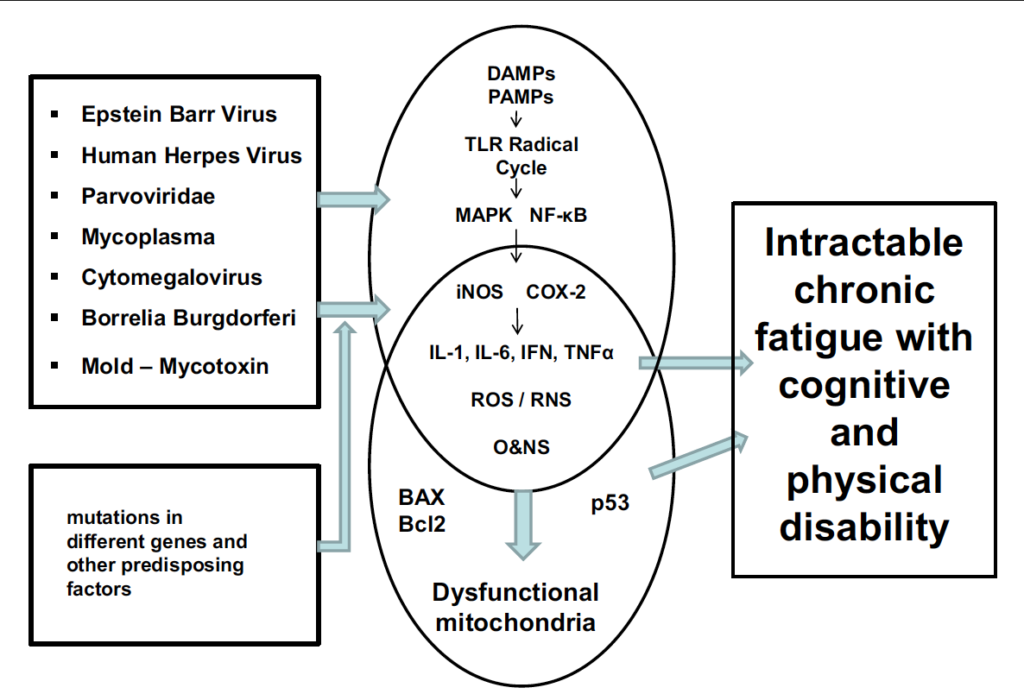
If basic testing fails to reveal a cause of your fatigue, you may want to have your doctor test for occult infection. More sophisticated investigations can reveal the presence of all kinds of pathogens capable of colonizing the body and evading the immune system.  Some of them include: Parvoviruses, HHV6, Epstein-Barr, Cytomegalovirus, Mycoplasma, and Borrelia burgdorferi. Other patients have a history of chronic fungal infections or biotoxin exposure.  A history of chronic mold exposure is a feasible explanation for such symptoms, as is the presence of B. burgdorferi.
Chronic fatigue syndrome is a complicated disorder characterized by extreme fatigue that can't be explained by any underlying medical condition. The fatigue may worsen with physical or mental activity, but doesn't improve with rest.
Chronic fatigue syndrome has eight official signs and symptoms, plus the central symptom that gives the condition its name:
  • Fatigue
  • Loss of memory or concentration
  • Sore throat
  • Enlarged lymph nodes in your neck or armpits
  • Unexplained muscle pain
  • Pain that moves from one joint to another without swelling or redness
  • Headache of a new type, pattern or severity
  • Unrefreshing sleep
  • Extreme exhaustion lasting more than 24 hours after physical or mental exercise
If you see a good medical detective, a physician trained in functional medicine, they can work with you to test for any of these underlying causes of the fatigue,
A study of 375 patients with apparently no cause for their disabling fatigue revealed pathological stimulation of white blood cells with abnormally elevated patterns of natural helper and natural killer cells, important infection fighting agents in the immune system in 53% of patients.  It showed depleted levels of IgG subclass three in 59% of the study population.  More than 50% had circulating immune complexes and many tested positive for ANA antibodies, usually seen in autoimmune diseases like lupus.


Why is it that some patients who get an infection recover and have no fatigue and others may be colonized with pathogens and suffer from intractable lack of energy?

It appears that part of the answer lies in the genetic polymorphisms or variances in our bodies response to infection and inflammation.  For those who develop severe fatigue in response to toxic exposure, like mold or infection, their immune systems respond more robustly to the threat with massive production of cytokines, like IL-ß1 or TNF-alpha.
Moreover, polymorphisms in TNF-alpha,IL-1β, interferons (IFNs), IL-6, and IL-10, acting together or separately can make the severity and response of immune system more profound in response to infection.  Why does this happen?  Well these pathogens can trigger TLR's (toll-like receptors) by either PAMPs (pathogen-associated molecular patterns) or DAMPs (damage associated molecular patterns).  Activation of the TLRs causes a massive cytokine surge that becomes like a domino-effect and keeps on going unrelenting in susceptible individuals, contributing to the inflammation, depression and fatigue.  This vicious cycle of pro-inflammatory cytokines that continue to trigger more inflammation and amplify the cycle, leading to more damage and inflammation.
The initial infection followed by chronic inflammation of the immune system could explain the cause of fatigue in these genetically susceptible individuals.  Some patients also suffer from cognitive dysfunction, memory loss, or brain fog as well.

What are some common hidden infections that may be causing your fatigue?

  • Epstein Barr Virus (EBV)
  • Cytomegalovirus (CMV)
  • Human Herpes Virus (HHV-6)
  • Parvovirus (Parvo B19)
  • Mycoplasma sp.
  • Borrelia Burgdorferi
  • Chronic mold and mycotoxin exposure
Chronic fatigue syndrome is just a label.  It's useful to identify a group of symptoms that causes significant fatigue and may affect one's life dramatically causing inability to function or hold a job. It does not represent one clincial entity but the cause may be multi-factorial and different in each individual.  It may share a final common pathway of dysfunctional immune activation and inflammation that keeps on going in a self perpetuating manner (like the Energizer Bunny gone bad!)  From a functional medicine perspective it's important to get to the root cause of the chronic fatigue symptoms and cognitive impairment.   Most of these infections, including the inflammatory response (CIRS) to mold and mycotoxins can be measured by ordering conventional lab testing through a knowledgable practitioner.  Ask your doctor to see if he can help you determine the root cause of your fatigue.  Treating the root cause (or infection in this case) just might give you back your life!

References:

  1. The Putative Role of Viruses, Bacteria, and Chronic Fungal Biotoxin Exposure in the Genesis of Intractable Fatigue Accompanied by Cognitive and Physical Disability
  2. A narrative review on the similarities and dissimilarities between myalgic encephalomyelitis/chronic fatigue syndrome (ME/CFS) and sickness behavior

13 January 2013

Influenza Blues? Seven Tips to Prevent Infection...

Cold and flu season are in full swing.  I frequently get asked if I recommend the flu vaccine.  My answer is simple...  a healthy immune system is the best defense against colds and flu.  If you have an immune deficiency or other serious illness it may be appropriate.  However, for the rest of us, strengthening your innate immunity is the key!  Besides, who willingly has formaldehyde, aluminum, MSG, or thimerosal injected into the body, anyway?

Seven Tips for Preventing and Treating Viral Infections:
  1. Basic Immune Nutrients - Make sure you are getting adequate immune supporting vitamins.  I recommend Vitamin D3, Vitamin C, Zinc, Omega-3 Fish Oil and high potency probiotics as some of the basics
  2. Hydration & Sleep - Often overlooked but essential!  Drink plenty of fluids and avoid sticky and sweet soda or fruit juice.  Get 7-8 hours of sleep per night.  It is no coincidence that we often get a cold or the flu after activities like the holidays or travel, when we return to high stress and fail to get adequate sleep.
  3. Homeopathic Medicines - One of my very favorite homeopathic flu remedies is Boiron Oscillococcinum.  I am never without this helpful cure!  It comes in adult or kid friendly versions.  Take 1 vial weekly for prevention of flu. My husband & I do this all through the winter months or when flying.  Upon the first sign of sore throat, fever or myalgias, take one vial up to 3X daily for acute illness.  It's safe at any age and has been shown to limit the severity and duration of the flu symptoms.  For best results, take at the very beginning of symptoms.  Some of my other favorites by Boiron are ColdCalm for cold symptoms and Sinusalia for sinus symptoms.
  4. Elderberry - Elderberry syrup (such as Sambucol) is a great alternative to anti-viral medication.  Take one tablespooon 4X daily for up to 3 days when symptoms begin.  One study suggested that using a standardized elderberry extract, Sambucol, could shorten the duration of flu by about 3 days.
  5. Avoid sugar - Perhaps the most important thing you can do to boost your immune strength is get rid of the sweets!  Avoid all sugar and highly processed foods.  Even small amounts of sugar can significantly impair the immune system, making one more susceptible to a flu infection.  One classic study showed that sugar decreased neutrophil activity (your cells that fight infection) for hours after sugar ingestion.
  6. Functional Foods - Many foods are helpful to boost immunity.  Drink organic green tea, eat garlic raw or cooked, use fresh oregano and thyme to spice your foods, and enjoy fresh ginger in cooking or smoothies or make a cup of honey ginger tea.  Cruciferous veggies and certain mushrooms are also loaded with immune boosting properties.  Both garlic and onions contain compounds that rev up the activity of immune-system cells called natural killer cells and T-helper cells.
  7. And don't forget to wash your hands... a simple but effective way to wash away the viruses that cause cold and flu.  Use plain soap and water (NOT the anti-bacterial soaps which contain the toxin, Triclosan)  Make your own hand sanitizer with the following simple recipe.
    • Fill 4oz glass spray bottle with sterile water
    • Add 1 tsp aloe vera gel
    • Add 5 drops each of the following essential oils:  cinnamon, clove, rosemary, eucalyptus
    • Mix 10 drops of lemon or wild orange essential oil
    • Shake gently and use 2-3 sprays on your hands as needed.
Take to heart these simple tips and you should be WELL on your way to a healthy, happy, virus-fighting immune system this flu season!